Explore the Arctic tundra, island-hop around scenic archipelagos, cruise majestic fjords, and hike magnificent landscapes under a never setting midnight sun. These experiences and more make up ten ways to enjoy the very best of summer in Norway.
Island Hop Around the Lofoten Islands
Find idyllic Norwegian fishing communities—characterized by old red cabins on stilts called rorbu, docked fishing boats, and racks of drying stockfish (unsalted dried cod)—scattered all over the Lofoten Islands. Surrounded by dramatic craggy mountains and with views of Vestfjord that stretch to the east of the Lofoten Islands for roughly a hundred miles, the capital of Svolvær and its tranquil harbor are a great base for island-hopping via ferries.
Sample local fish dishes such as cod, haddock, and ling. Home to the world’s largest known cold-water coral reef, the Røst Reef, the Lofoten Islands are perfect for deep-sea fishing. For sports fishermen, the islands host the World Championships in Arctic cod fishing every year. Beyond its panoramic beauty and fishing culture, enjoy soft adventure activities such as kayaking, hiking, and biking around its mountainous peaks—a testament to Norway’s unparalleled beauty.
The New South China Mall in Dongguan, China is the biggest in the world. With an area of over 7 million square feet that can accommodate 2,350 stores, and attractions such as roller coasters, ghost trains and a replica of the bell tower of St Mark’s Square in Venice, you would think the place would be swarming with people. So did the owners of the mall, who expected over 70,000 visitors a day when they started building it. But today it stands empty, with almost no customers entering its gates. The 553 meter indoor and outdoor roller coaster hasn’t been operated since it was installed and 99% of the shops have never been leased out. The only ones that do operate are a series of fast food joints at the entrance of the mall and another few shops inside the huge complex. New South China Mall was built in 2005 by Hu Guirong, who made his millions making instant noodles. He started the project with great enthusiasm, sending teams all over the world in search of ideas for his dream mall. And most of these ideas were even translated into reality. Where else in the world would be able to see a gondola on a mock Venetian canal inside a mall? But then something went horribly wrong, because when the place was completed in 2005, it simply failed to take off. It wasn’t even a dead mall, where tenants simply depart and business winds down slowly. No, Guirong’s mall never attracted merchants in the first place, as they felt it wasn’t a realistic place to set up shop.
The failure of New South China mall has surprised many, especially since China’s consumer culture is growing by the day. According to retail analyst David Hand, “The Chinese people love shopping, they love brands, and they love international products, even though the average income is low. New shoppers are born every day. We won’t run out of them.” But some people aren’t surprised that the it failed to take off. Retail consultant Dick Groves says that New South China mall failed due to inexperience in the leasing business and the lack of a sound financial system. “When it’s easy to get financing without having to convince someone of the project’s feasibility, and without having to show pre-leasing commitment, you can start to get into trouble,” he points out.
It’s rather sad to see pictures of the deserted mall. All that space, hard work, money and resources gone to waste. Well, if you would like to take a closer look at its interiors, a documentary is available on YouTube called “Utopia Part 3: the World’s Largest Shopping Mall”. Made by Academy Award-nominated filmmaker Sam Green, the documentary premiered at the 2009 Sundance Film Festival. The film offers several explanations for the failure of the colossal project.
The world's first indoor city: a greatest hits mashup of London and New York
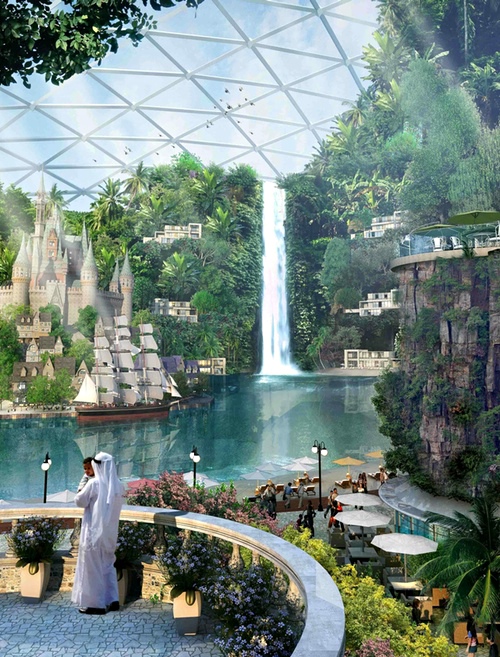
Dubai's Mall of the World will have its very own Oxford Street and Broadway. It will also have galleons, waterfalls, a giant retractable dome – and be climate-controlled
A retractable glass dome worthy of Kubla Khan ... Mall of the World. Photograph: AFP/Getty. Click to see full image -/AFP/Getty Images
For the desert city-state that has the tallest building in the world, as well as the biggest flower garden and largest aquarium on the planet, plus islands shaped like palm trees, buildings in the shape of sails, and an entire archipelago shaped like the world itself, there was only one obvious next step: building an entire city indoors. Unveiled this week, the Mall of the World is a vision for a climate-controlled leisure district, a place of hotels and shops, entertainment and healthcare, all connected by hermetically sealed avenues – 7km of them – along which trams will trundle. Launched with a fanfare by the emirate's ruler, Sheikh Mohammed bin Rashid al Maktoum, it is the first state-sponsored mega-project to emerge from Dubai since the light-headed days of the pre-crash bubble, when anything seemed possible, drunk on the tidal wave of petrodollars. After years of stalled cranes, sinking islands and litigious wrangling, the big plans are back – and they are more ambitious than ever before. Dubai's very own Broadway ... Photograph: AFP/Getty "We plan to transform Dubai into a cultural, tourist and economic hub for the two billion people living in the region around us," said Sheikh Mohammed as he launched the project in front of a sparkling model of the 48 million sq ft (4.5 million sq m) complex. "And we are determined to achieve our vision." A kind of pick'n'mix urban collage, the project samples bits of cities from around the world with gay abandon. There will be a "celebration walk" modelled on Barcelona's Las Ramblas, a bustling billboard-lined theatre district modelled on New York's Broadway, and a shopping area based on London's Oxford Street – all sealed under snaking bubble rooftops. There will be 20,000 hotel rooms and enough parking for 50,000 vehicles, servicing the largest shopping mall in the world, at 8 million sq ft (750,000 sq m). The centrepiece will be a vast "cultural celebration centre," shaped like a disco ball sliced in half and hollowed out to form a glittering backdrop to an outdoor amphitheatre. It will lead, via a triumphal covered avenue lined with spear-like towers, to a retractable glass dome worthy of Kubla Khan, beneath which will sprawl the "largest indoor theme park in the world." A place of fairytale castles and tumbling waterfalls, it will be protected from the blistering 40C heat in summer like the rest of the complex, and open up in winter to enjoy the balmy climate. Spot the world's biggest indoor theme park ... Photograph: AFP/Getty "Our ambitions are higher than having seasonal tourism," said Sheikh Mohammed. "Tourism is a key driver of our economy, and we aim to make the UAE an attractive destination all year long. This is why we will start working on providing pleasant temperature-controlled environments during the summer months." The project also seeks to capitalise on the Gulf's booming industry of healthcare tourism, with a 3 million sq ft (280,000 sq m) "wellness district," so you can shop till you drop, then pop in for a quick facelift. It follows the success of Dubai Healthcare City, a free economic zone home to 120 clinics and hospitals, at the centre of the state's plan to attract 500,000 medical tourists by 2020.
No timeframe or budget has yet been announced for the Mall of the World, but Dubai Holding, the state-owned development company behind the project, hopes it will be the emirate's main focus at the UAE World Expo trade fair in 2020. Dubai Holding is no stranger to dreaming big – but it hasn't always had an easy ride. Back in 2003, the company launched an ambitious plan for Dubailand, a gargantuan $64bn (£37bn) leisure district, planned to cover an area of 278 sq km, making it three times bigger than Walt Disney World. Slated to house 200 attractions, from a giant Legoland to a Marvel superheroes theme park, it was put on hold in 2008 – although cranes are once again moving and the first phase, the Miracle Garden, opened last year. With a recent Deloitte report suggesting that $12bn of the UAE's stalled construction projects are back on track, spurred on by the new deadline of the 2020 Expo, Sheikh Mohammed's stately pleasure-dome might be more than just a mirage in the desert.